What is BLE (Bluetooth Low Energy)?
Your smartwatch synchronizes the time with your phone, the fitness tracker reports the steps, the temperature Sensor in the warehouse transmits its value. Three different devices, yet often the same technology is at the core. It's called BLE, which stands for Bluetooth Low Energy, and its main trick is not to transmit a lot, but to consume very little power. This article explains what BLE is, how it works, how it differs from classic Bluetooth, and where it is used in industrial operations.

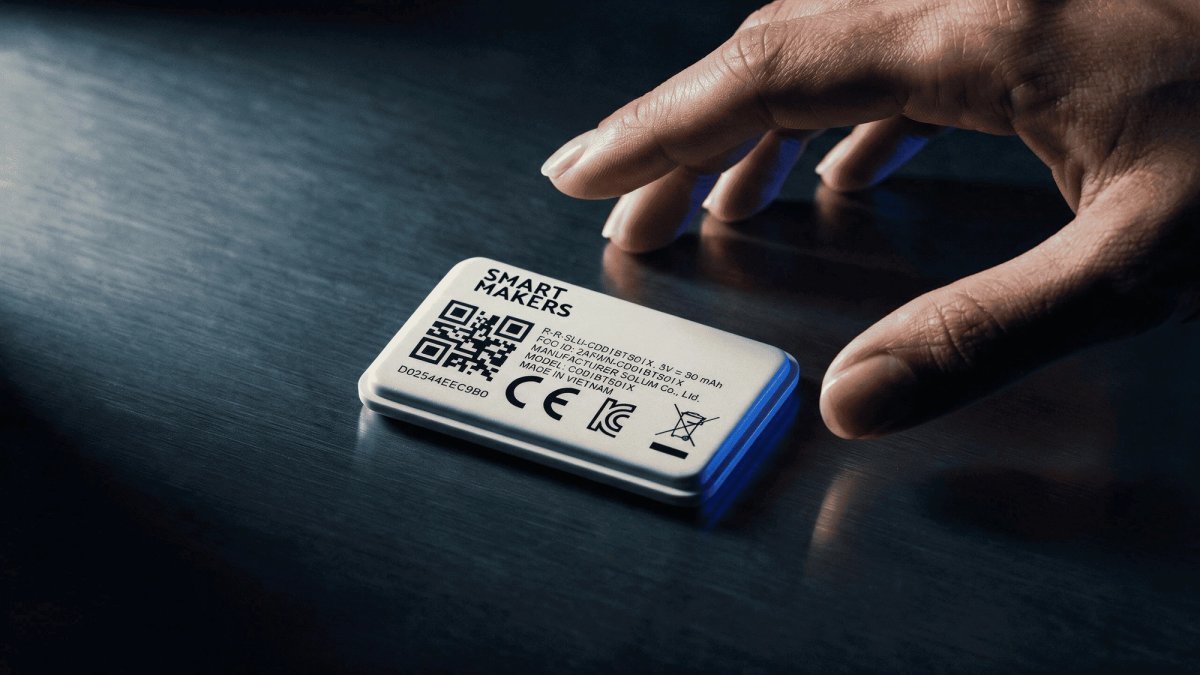
What is Bluetooth Low Energy (BLE)?
BLE (Bluetooth Low Energy) is a low-power radio standard from the Bluetooth family. It is designed to transmit small amounts of data with minimal energy consumption. This is its strength: A BLE device can operate for months or years on a small battery.
Why "Low Energy"? The difference from classic Bluetooth
Classic Bluetooth, which you know from music streaming, maintains a continuous connection and transmits larger amounts of data continuously. BLE does the opposite. It briefly checks in, sends its few data, and goes back to sleep. This principle saves power.
In industrial environments, where a Sensor often transmits infrequently and sleeps almost completely in between, it can last for several years without issue.
How does BLE work technically?
BLE operates in the license-free 2.4 GHz band—the same range used by your Wi-Fi. The advantage: The technology is proven millions of times and works even where many radio sources are active simultaneously. You can think of it as a well-established traffic lane with a lot of traffic already flowing. BLE integrates without disrupting existing operations.
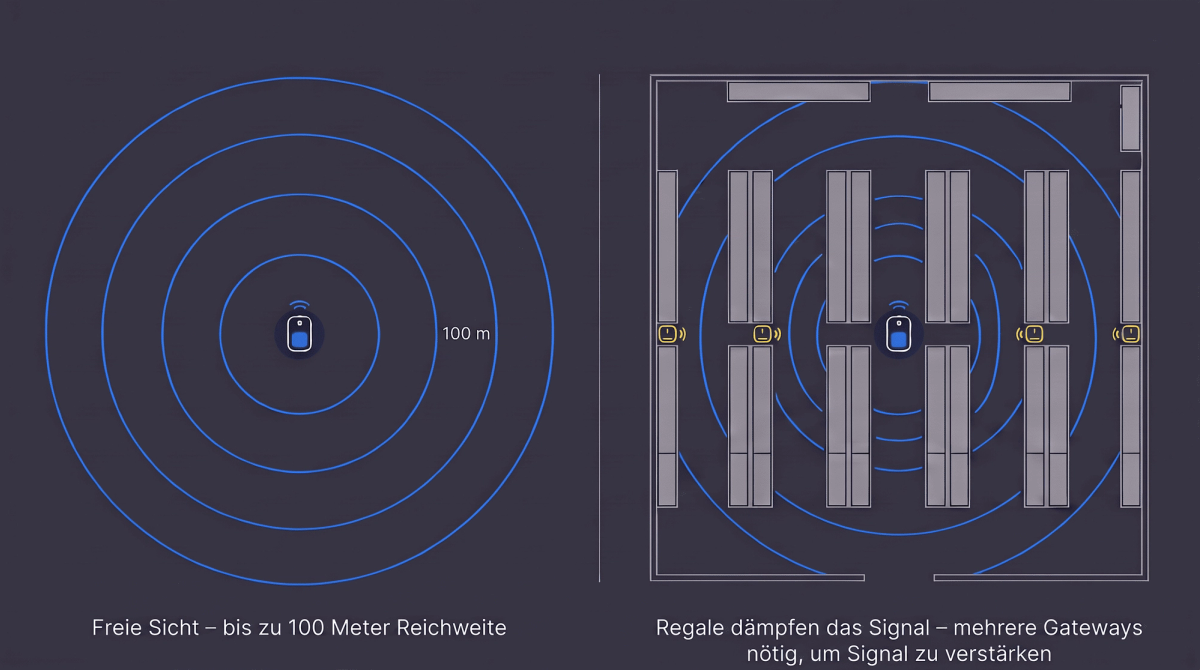
In practice, however, the technology matters less than the question: What actually reaches the hall? The range depends heavily on the environment. In open sight, the Tags reach up to 100 meters, but shelves, metal, and machines absorb the signal, similar to how walls dampen Wi-Fi reception at home. For your planning, this means: The decisive factor is not the maximum number of meters on paper, but how many Gateways you need to reliably cover your area.
The biggest advantage in everyday life is that they rarely need maintenance, as the Tags only send for short periods. Comparable to a night watchman who only reports when he detects movement. This is why the battery can last for several years. This means you rarely have to change them, even if hundreds or thousands of Tags are in use.
Bluetooth Classic and BLE in comparison
| Feature | Bluetooth Classic | BLE (Bluetooth Low Energy) |
|---|---|---|
Power Consumption | higher (continuous operation) | low |
Connection Model | continuous connection | short bursts, rest mode in between |
Typical Uses | audio, streaming, hands-free | Sensors, Tags, Beacons |
Battery Life | shortened battery life due to continuous operation | several years (button cell) |
Typical Application in Operation | – | Asset Tracking, condition monitoring |
Bluetooth Classic
Power Consumption
higher (continuous operation)Connection Model
continuous connectionTypical Uses
audio, streaming, hands-freeBattery Life
shortened battery life due to continuous operationTypical Application in Operation
–
BLE (Bluetooth Low Energy)
Power Consumption
lowConnection Model
short bursts, rest mode in betweenTypical Uses
Sensors, Tags, BeaconsBattery Life
several years (button cell)Typical Application in Operation
Asset Tracking, condition monitoring
How BLE determines position
For BLE to not only transmit data but also be suitable for location tracking, it needs a method to convert a radio signal into a location. The common principle is signal strength, measured as RSSI. The idea is simple: The weaker the signal of a Tag received by the Gateway, the further away the Tag is. If multiple Gateways receive the same signal, the approximate position can be estimated.
It becomes more accurate with AoA, or Angle of Arrival. Instead of just evaluating signal strength, the system determines the angle of arrival of the signal. However, this requires more infrastructure.
In practice, this means: With RSSI, you can reliably identify the zone or area where an Asset is located. If you want more precision, the effort to build the infrastructure increases. In many applications in production and logistics, the cost and benefit do not justify the effort.
Typical applications of BLE
In everyday life
Modern devices often use both classic Bluetooth and BLE. It depends on the task. A smartwatch, for example, uses BLE for energy-efficient continuous tasks like synchronizing steps or notifications, but switches to classic Bluetooth when you listen to music or make a call. Rule of thumb: little data and long battery life means BLE, continuous transmission like audio means classic Bluetooth. The switching happens automatically in the background—you won't notice it as a user.
In the industry
In industrial environments, BLE primarily appears as a Sensor, Beacon, or Tag to capture many Assets simultaneously. An important distinction often overlooked in operation: A BLE Tag is a small transmitter without its own connection to the platform. It only sends its signal. It is located by the surrounding infrastructure, the Gateways or Anchors, which receive and forward the signal.
This is exactly the technology that the SmartMakers Active RFID BLE Tracking relies on: It is a BLE solution, consisting of BLE Tags and BLE Gateways.
BLE compared to other radio technologies
For location tracking and Asset Tracking, BLE competes with technologies like RFID, UWB, and LoRaWAN. All solve the same basic task, but with different strengths. The following table compares them.
| Technology | Range | Accuracy | Power Supply / Runtime | Cost Profile | Typical Use Case |
|---|---|---|---|---|---|
BLE | Tags up to ~ 100 m | Zone level (a few meters) | Battery, energy-efficient, several years runtime | cost-effective, for large quantities | many cost-effective Assets at zone level |
RFID passive | a few cm to ~10 m (depending on frequency) | point-in-time, snapshot at reading point | Tag without its own power source, reader supplies via radio field | very cost-effective Tags, reader infrastructure required | point-in-time capture at gate or handheld scanner |
UWB | ~50–100 m per anchor | Decimeter to centimeter (10–30 cm) | Battery, higher consumption, shorter runtime | infrastructure- and cost-intensive | high-precision location tracking where centimeters matter |
LoRaWAN | wide area (several km, less in buildings) | coarse (zone/GPS level, ~10–100 m) | very energy-efficient, years of runtime | cost-effective Tags, wide area network coverage | wide area location coverage |
Range
BLE
Tags up to ~ 100 mRFID passive
a few cm to ~10 m (depending on frequency)UWB
~50–100 m per anchorLoRaWAN
wide area (several km, less in buildings)
Accuracy
BLE
Zone level (a few meters)RFID passive
point-in-time, snapshot at reading pointUWB
Decimeter to centimeter (10–30 cm)LoRaWAN
coarse (zone/GPS level, ~10–100 m)
Power Supply / Runtime
BLE
Battery, energy-efficient, several years runtimeRFID passive
Tag without its own power source, reader supplies via radio fieldUWB
Battery, higher consumption, shorter runtimeLoRaWAN
very energy-efficient, years of runtime
Cost Profile
BLE
cost-effective, for large quantitiesRFID passive
very cost-effective Tags, reader infrastructure requiredUWB
infrastructure- and cost-intensiveLoRaWAN
cost-effective Tags, wide area network coverage
Typical Use Case
BLE
many cost-effective Assets at zone levelRFID passive
point-in-time capture at gate or handheld scannerUWB
high-precision location tracking where centimeters matterLoRaWAN
wide area location coverage
One aspect deserves special emphasis because it is often misunderstood: Passive RFID is not a real-time location system. It captures objects at the reading point and documents that a product has passed through a gate at a specific time, but not where it is currently located.
When BLE is the right choice and when it is not
BLE excels where scalability and cost-effectiveness are important, and location tracking at the zone level is sufficient. It reliably tells you in which area an Asset is located, and that for a large number at attractive costs. For the majority of applications in industrial operations, this is exactly the information that matters.
UWB provides location tracking down to the centimeter, but this precision comes at a high cost: with complex infrastructure, dense anchor networks, and correspondingly high investment and operating costs. In most cases, this is significantly more than the operation actually needs. Precision that rarely adds value in everyday life but requires high initial investments in infrastructure and also brings higher effort in operation.
How to use BLE effectively in your operation
Where does BLE bring concrete benefits in the everyday life of production and logistics?
A few typical situations you are likely to recognize.
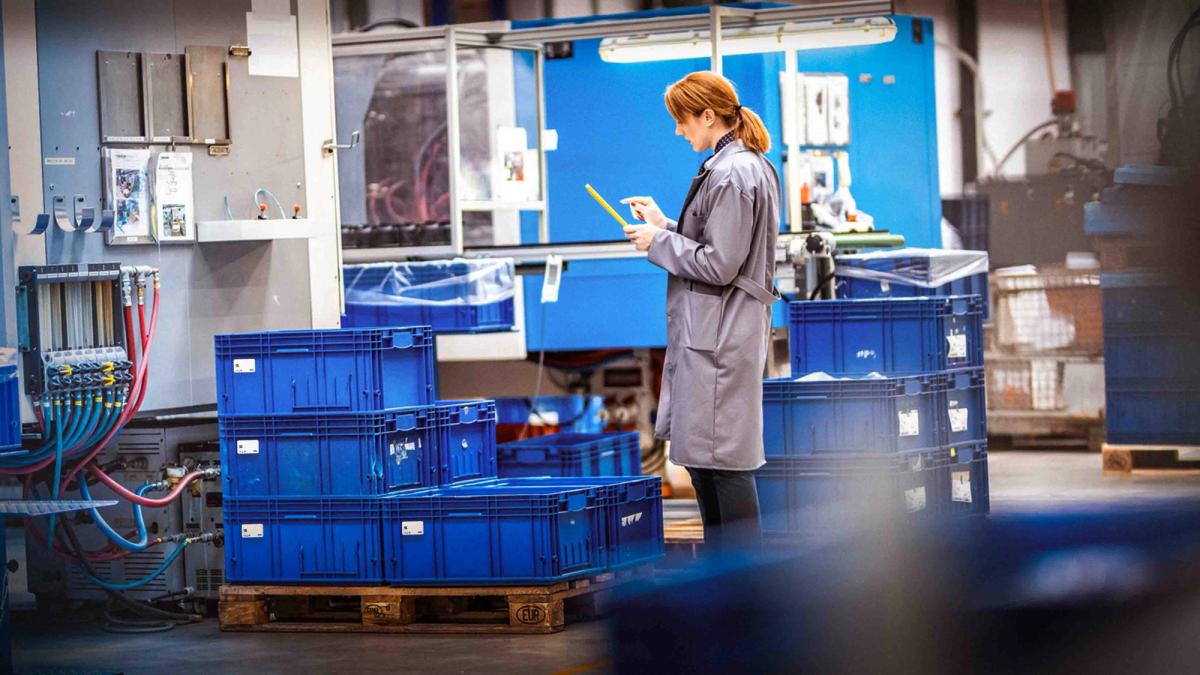
Find load carriers and containers: The classic. Mesh boxes, pallets, roll containers, KLTs. Operating resources that are constantly on the move and regularly disappear. With a Tag on each carrier, you can see at a glance where everything is, instead of walking through the hall. The search is eliminated.
Keep track of tools and special equipment. Especially in the production of individual products, there are expensive special tools that are only needed temporarily. But exactly at that moment, they are not found. A BLE Tag makes them visible as soon as someone searches for them.
Make order progress visible. If an order box or workpiece carrier with a Tag moves through the stations, you can see where an order is without manual scanning. As the box approaches station 5, the system knows it automatically. No employee has to book at each station anymore.
Control container cycles. How many load carriers are currently in circulation? Which are loaded or empty? How long have they been on the move? BLE provides the data basis to control cycles instead of estimating. Many companies find for the first time that they have significantly too many carriers in circulation. Again, expensive capital that is tied up.
Monitor zones and deviations. If a container enters an area where it doesn't belong, the system automatically reports it. If a container remains unusually long at a station, it is immediately noticeable. Not only when the colleagues at the next station run idle.
The common thread through all these examples: Not the human captures the physical world, the physical world reports itself. This is exactly what relieves the people who keep the operation running.
How this looks in the SmartMakers solution
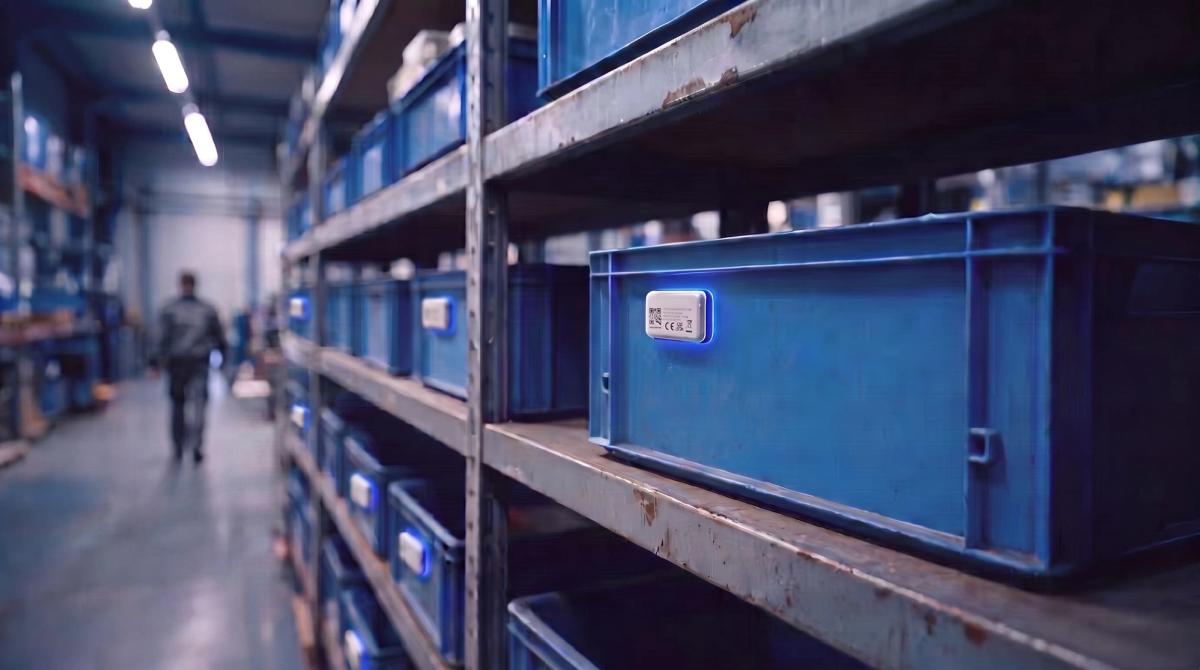
How does such a BLE solution look in practice? The SmartMakers Active RFID BLE Tracking is an example: cost-effective BLE Tags and Gateways provide inventory transparency at the zone level, i.e., the real-time location of small operating resources at a fraction of the cost of traditional RFID systems.
It becomes interesting at the zone boundaries. Through a Geofence—a virtually defined area—the entry or exit of an Asset automatically triggers an event, such as a booking in the ERP or warehouse management system. The booking record thus arises from the actual movement, not from a manual entry. This is where the role of your employees shifts: away from scanning and searching, towards controlling.
And thus, BLE is not an isolated tracking tool, but a component of Realtime Operations. The principle that your operating resources become intelligent colleagues and status data automatically flows into your processes. Load carriers, containers, and tools become active participants in the process: They provide information about their location instead of waiting to be found.
And the best part: The different radio standards converge in a single Realtime Operations platform. Whether BLE at the zone level or GPS Asset Tracking for outdoor use. Together, they create a comprehensive picture of your operations that even extends beyond the factory boundaries.
Frequently Asked Questions about BLE (Bluetooth Low Energy)
BLE stands for Bluetooth Low Energy, a low-power radio standard from the Bluetooth family. It is designed to transmit small amounts of data with very low energy consumption, enabling long battery life. Typical applications include Sensors, Beacons, and Tags, such as for Asset location tracking.
BLE is part of the Bluetooth standard but not identical to classic Bluetooth. Classic Bluetooth (Bluetooth Classic) is designed for continuous transmission of larger amounts of data, while BLE is for energy-efficient transmission of small amounts of data.
The main difference lies in power consumption and connection model: BLE consumes significantly less power and transmits in short intervals, while Bluetooth Classic is designed for continuous connections with higher data rates.
A BLE device is a device that communicates via Bluetooth Low Energy. This ranges from everyday devices like wearables to industrial Sensors and Tags. In Asset Tracking, a BLE Tag is a small transmitter that does not use its own network but is located via surrounding Gateways or Anchors.
The range depends on version, environment, and hardware. The BLE Tags in SmartMakers Active RFID / BLE Tracking reach up to 100 meters.
BLE is used to capture a large number of cost-effective Assets that are constantly in motion, with zone-level accuracy. By using it, you know which Asset is in which area. It is suitable for large quantities, in the range of 50,000 to 250,000 units.
A BLE Tag is a small, battery-powered transmitter that sends a signal at intervals. It does not have its own connection to the platform but is received and located by the surrounding infrastructure. This allows many objects to be tracked simultaneously at low cost.